Was this email forwarded to you? Subscribe for bi-monthly emails from PWN in your inbox!
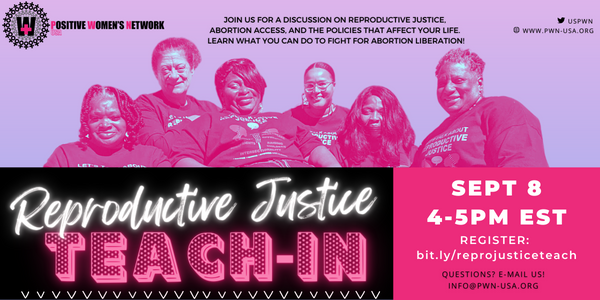
On June 24th, the U.S. Supreme Court eliminated the constitutional right to abortion. States across the U.S. have already begun to eliminate access to abortion and anti-choice lawmakers are pushing for the nationwide ban they’ve wanted all along. Are you outraged? Are you furious and ready to fight? Join PWN-USA for our Reproductive Justice Teach-in on September 8, 2022 at 4pm ET! We will be having a community discussion about what reproductive justice is, what it means for the HIV movement, and steps you can take for reproductive freedom. Register here.
The U.S. declared monkeypox (MPV), the disease caused by the monkeypox virus, a public health emergency on August 4. There are currently more than 16,000 total confirmed cases in the U.S. MPV is the latest failure of our fractured health care system and the federal government’s “wait and see” approach to pandemic response. Vaccines and medications are out of reach for most people because of governmental delay, inaction and miscommunication. Health departments are chronically under-funded, overwhelmed, and still reeling from the COVID-19 pandemic. Testing delays and muddled public health messaging have all contributed to the failure. So have institutional racism and homophobia.
First and foremost, anyone who has had close physical contact with someone with MPV can acquire the virus. Acquisition and transmission are not specifically limited to any gender, sexual orientation, or sexual behaviors. That said, CDC data shows that in the United States, Black and Latinx men who have sex with men are overwhelmingly impacted by MPV (and yet not surprisingly, white men have received the majority of MPV vaccinations). It is imperative to ensure resources are equitably directed towards communities most impacted, in this case Black and Latinx men who have sex with men, while combating the misinformation that suggests only gay men contract MPV. The public health response in the U.S. has failed to toe that line, instead opting for either silence or stigma.
We have seen the same problems and disparities repeat themselves in the HIV epidemic, COVID-19, and now, MPV. Our institutions (healthcare and beyond) were designed to put the same people in harms way: queer and trans folks - primarily Black, Indigenous and other people of color. And when systems don’t change, the results are repeated.
After criticism of their response to COVID-19 and MPV pandemics, the CDC has announced that it will make sweeping changes. The plans include emphasizing quicker response to public health issues, creating an equity office, addressing the problem of rapid turnover, fostering more collaboration with other agencies, and making public health messaging clearer and more accessible to the public. CDC Director Dr. Rochelle Walensky also plans to ask Congress for the power to require that all state health agencies and counties share their data with the CDC.
MPV and HIV: What you need to know. According to the National Institutes for Health, MPV does not appear to be more severe for people living with HIV who are virally suppressed. People with lowered immune systems may, however, be at risk for more severe illness and may not respond as well to the MPV vaccine. Antiviral treatments are available for people exposed to MPV or diagnosed with MPV. Vaccination is recommended for people exposed to MPV and those more likely to acquire MPV, including Black and Latinx men who have sex with men. Treatment and vaccination for MPV do not appear to negatively interact with HIV treatment or PrEP.
The “hot topic” (above) is a deeper dive into one of the most pressing policy-related issues each month for people living with HIV and our communities. But a lot happens each month! Below we list some other important updates relevant to PWN-USA’s intersectional policy agenda.
Access to Healthcare
Reproductive Health Rights and Justice
LGBTQ+ Health, Safety & Justice

Ending Criminalization
Economic Justice
Ending Violence

One signup covers the monthly newsletter, policy updates, and statements. No spam. Unsubscribe at any time.


